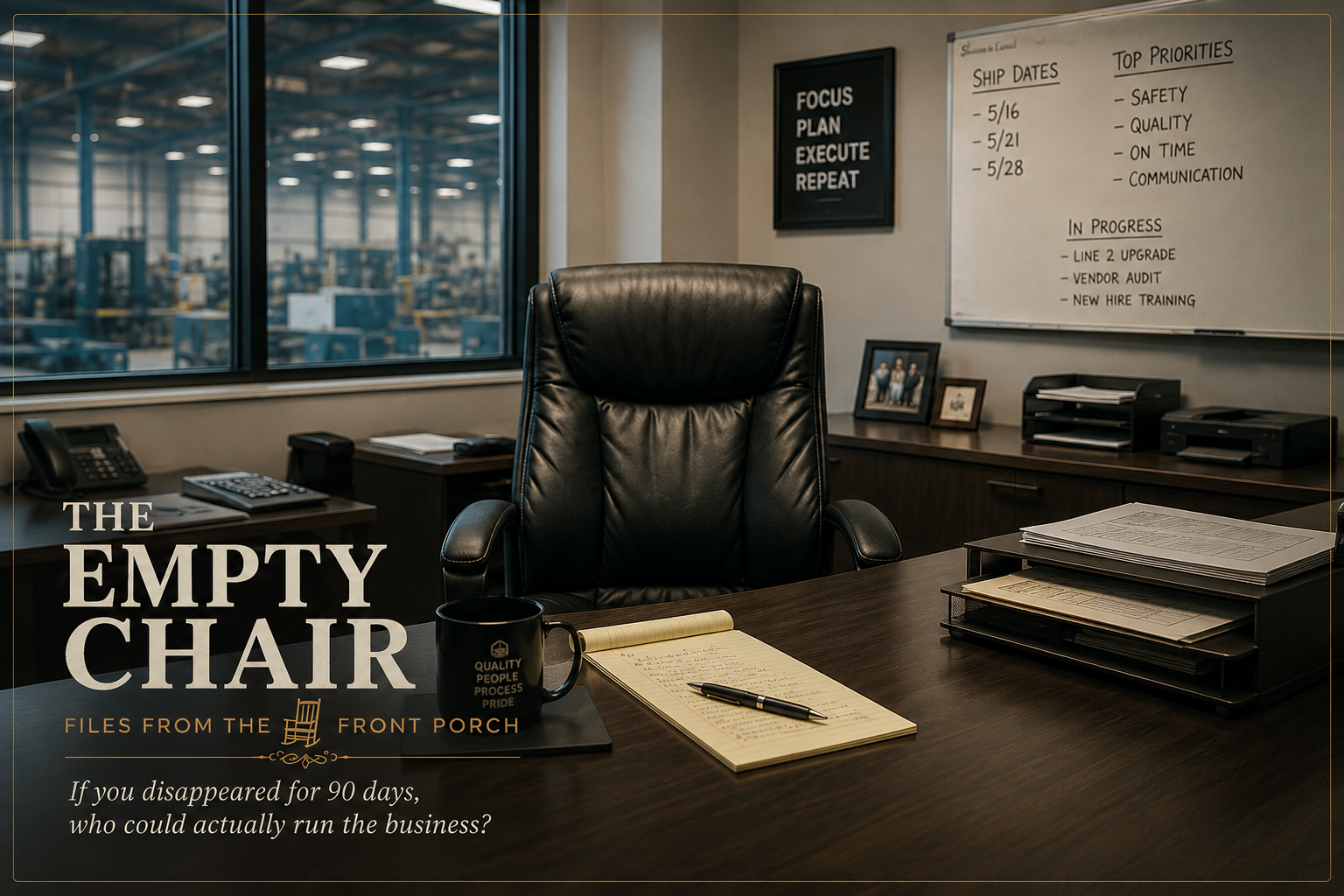
THE EMPTY CHAIR
A few years ago, I was talking with a business owner who was pretty proud of what he'd built.
Honestly, he had earned the right to be.
The company had survived Covid, recessions, supply shortages, employee turnover, crazy customers, and a few economic predictions that should probably be investigated by law enforcement.
He had been in business for over 20 years.
The business was profitable.
From the outside, it looked solid.
At some point in the conversation, I asked him a question.
Not a legal question.
Not an estate planning question.
Just a question.
"If you disappeared for 90 days, who could actually run the business?"
He laughed.
Then he stopped laughing.
Like a lot of business owners, he had spent years building a successful company.
What he hadn't built was a plan for the day he couldn’t be there.
Most business owners assume continuity planning means deciding who gets the company when they die.
That's part of it.
But it is usually not the first problem.
The first problem is who runs it tomorrow morning.
Who can access the accounts?
Who can approve payroll?
Who can deal with the bank?
Who can sign the contract that has to go out tomorrow?
Who can make decisions while the owner is lying in a hospital bed unable to answer the phone?
Those questions show up long before anyone starts reading a Will.
That's where business planning and estate planning stop being separate conversations.
Payroll still has to run.
Customers still expect answers.
Employees still show up Monday morning.
And suddenly everyone discovers that ownership, authority, and access are three very different things.
I've seen spouses inherit a business but have no practical ability to run it.
I've seen employees who knew how everything worked but had no authority to do anything.
And I've seen authority that existed on paper, but nobody knew where the paper was.
Those are not legal failures.
Those are continuity failures.
The problem is that real life showed up before anyone tested whether the plan actually worked.
Most small businesses are not built on systems.
They're built on memory.
The owner's memory.
The owner's relationships.
The owner's experience.
The owner's cell phone.
The owner's passwords.
The owner's ability to answer a question in thirty seconds that would take somebody else three days to figure out.
And one day, whether because of illness, injury, or something far more permanent, that chair sits empty.
Most business owners think estate planning answers the question:
"Who gets the business?" And that's an important question.
But for many families, the harder question is:
"Who can run the business until then?"
Because businesses rarely fail all at once.
Usually, it starts with smaller things.
A missing password.
An unsigned check.
A bank that needs authorization.
A customer who needs an answer.
An employee who doesn't know who is in charge.
That's why business planning and estate planning cannot live in separate binders on separate shelves.
Eventually, life brings business planning and estate planning together.
The only question is whether you do it around a conference table...
or around an empty chair.