PASSWORD PROTECTED.
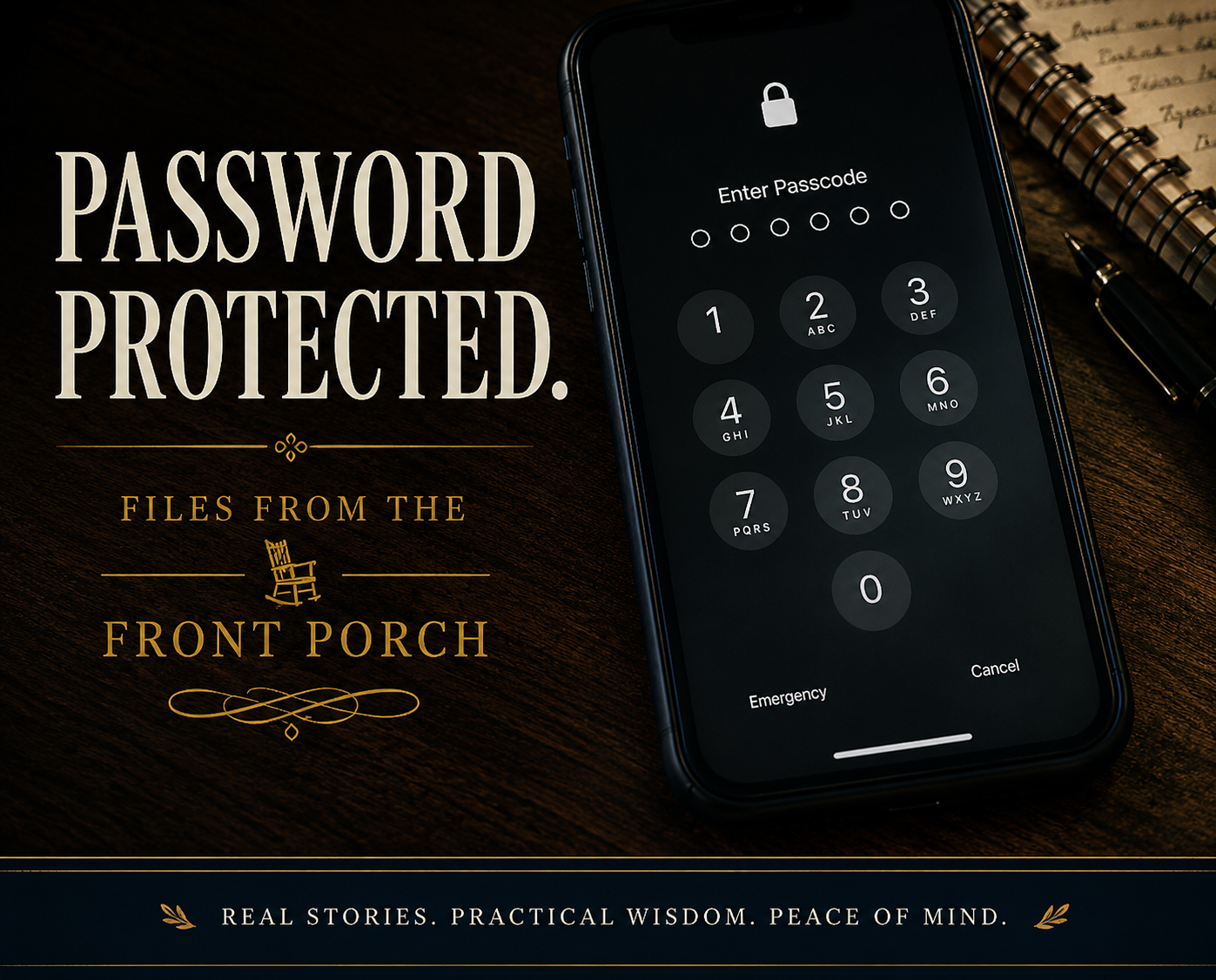
Over the past year or so, I've noticed a new question showing up with surprising regularity.
It hasn’t come from clients sitting across my conference table.
It has come from surviving spouses.
Children.
Executors.
Sometimes it's a phone call to my office.
Sometimes it's a Facebook post from someone who's simply exhausted.
The wording changes.
The frustration doesn't.
"I'm the executor...but Apple won't talk to me."
"I've spent six hours on the phone with Google trying to get into Dad's account."
"The bank keeps sending a verification code to his phone...and nobody can unlock it."
"I know I'm supposed to handle the estate. I just can't get past the password."
Thirty years ago, those conversations didn't exist.
Families searched for deeds.
Insurance policies.
The key to the safe deposit box.
Today...
they're searching for a password.
We used to inherit people's belongings.
Now we inherit their logins.
Estate planning has changed.
Not because families have changed.
Because life has.
Every generation leaves something behind.
Ours may be the first to leave behind an entire life protected by a password.
We don't just leave behind houses and heirlooms anymore.
We leave behind subscriptions.
Cloud storage.
Digital photographs.
Cryptocurrency.
Social media accounts.
Thousands of emails.
Years of text messages.
Entire lives that exist behind a screen.
And one device often holds the keys to all of it.
Think about how much of your life lives inside your phone.
Your banking app.
Your retirement account.
Your email.
Your contacts.
Your password manager.
Your family photographs.
Your notes.
The text message with the verification code that unlocks everything else.
A smartphone isn't just another possession anymore.
It's the front door to an entire digital life.
Here's what surprises most people.
The estate plans I've seen in these situations weren't broken.
The wills were signed.
The trusts were funded.
The powers of attorney were in place.
The legal plan worked exactly the way it was supposed to.
The technology didn't particularly care.
Apple wasn't being difficult.
Google wasn't being unreasonable.
The bank wasn't trying to make life miserable.
They were doing exactly what they were designed to do.
Protect someone's privacy.
The problem is that privacy doesn't automatically become accessibility when someone dies.
A court can appoint an executor.
A will can nominate one.
A trust can authorize a trustee.
None of those things automatically unlock a phone.
One conversation, in particular has stayed with me.
A woman called my office after spending most of her morning bouncing from one customer service representative to another.
She wasn't arguing about money.
She wasn't fighting with family.
She wasn't trying to contest a will.
She was just trying to get into her husband's phone.
Finally, somewhere between Apple, the bank, and another verification code that kept getting sent to a device she couldn't unlock, she sighed and said,
"I never imagined I'd spend more time talking to tech support than the funeral home."
That sentence has rattled around in my head ever since.
Because it's true.
Settling an estate doesn't just involve lawyers, bankers, and county clerks anymore.
Sometimes it involves Apple.
Google.
Microsoft.
Facebook.
And a customer service representative trying to verify the identity of someone who can no longer answer the phone.
The good news?
This is a problem with a solution.
Not by writing every password on a sticky note tucked into your will.
But by making digital access part of your estate plan.
Who knows how to access your password manager?
Have you named a Legacy Contact?
Does someone know where your important digital information is stored?
Have you left instructions, not just assets?
Those are conversations worth having long before anyone needs them.
So here's one question to take with you.
If something happened to you tonight...
Would the people you love know how to access your digital life?
Not necessarily your passwords.
But your plan.
Because those are two very different things.
One of the quiet truths about estate planning is that the biggest problems are rarely the dramatic ones.
They're the ordinary moments no one sees coming.
A safe deposit box with no key.
A deed no one can find.
A voicemail someone can't bear to delete.
Or six little circles on a phone screen.
Waiting.
Because sometimes the hardest part of settling an estate isn't what's in the courthouse.
It's what's behind a password.